Deepfake Detection: How Accurate Is AI Tools, and When Do They Fail?
A Comparative Analysis
Deepfake detection models are often said to achieve accuracy rates above 98% when tested under controlled laboratory conditions. While these results appear promising, they do not always reflect how the models perform in real-world situations. This report compares three peer-reviewed studies published between 2022 and 2023 to examine how detection accuracy changes when models are tested under more challenging conditions, including adversarial attacks and previously unseen datasets. The comparison focuses on reported accuracy rates, test datasets, and performance changes across video and audio detection, as well as cross-dataset evaluation. Overall, the studies show that although deepfake detection models perform well under ideal conditions, their accuracy drops noticeably when the testing environment changes. Results suggest that deepfake detection models tend to experience greater performance loss under cross-dataset testing than under adversarial attacks, showing limited generalization beyond training data.
Most people assume that if a video looks real, it is. As artificial intelligence continues to improve, that assumption is becoming less reliable. Deepfake technology can now generate realistic videos and cloned voices that are often difficult to distinguish from authentic recordings. Although this technology has useful applications in entertainment and education, it has also been used to spread misinformation, commit fraud, and impersonate public figures. One well-known example occurred in 2021, when criminals used an AI-generated voice to convince a bank manager that a company director had authorized a multimillion-dollar transfer. The money was transferred before anyone realized the voice had been artificially created (Dixit et al., 2023). Deepfakes have also been used to spread misleading videos of political figures and public officials, making it increasingly difficult for people to decide whether online content is genuine. As these incidents become more common, reliable methods for detecting deepfakes have become increasingly important. To address this problem, researchers have developed artificial intelligence models that can show manipulated videos and audio with high reported accuracy. However, those accuracy numbers are usually measured under ideal testing conditions. When the same models are evaluated using unfamiliar datasets or are exposed to adversarial attacks designed to fool them, their performance often declines. For example, Asha et al. (2023) reported that one detection model achieved 98.4% accuracy under normal testing conditions but dropped to 74.27% when subjected to adversarial attacks. Likewise, Saif and Tehseen (2022) found that several models reporting nearly perfect accuracy on their original datasets dropped to about 54% when evaluated using different datasets. These types of testing conditions more closely stand for how deepfake detection systems would perform outside a laboratory. This report compares findings from three peer-reviewed studies to better understand how different testing conditions affect deepfake detection accuracy, focusing on where these models begin to fail and whether the same weaknesses appear across studies.
Before reviewing the results, I expected cross-dataset testing to reduce accuracy more than adversarial attacks. I hypothesized that a model trained on a single dataset would learn dataset-specific patterns rather than generalizable features of manipulated media, leading to reduced performance on unfamiliar datasets.
This report used a comparative analysis rather than an experimental approach. Instead of collecting new data, I examined three peer-reviewed studies published between 2022 and 2023 that evaluated the performance of deepfake detection models. The studies were selected because they used well-established datasets, reported their results with clear numerical accuracy values, and tested their models under both standard and challenging conditions, including adversarial attacks, previously unseen datasets, or both. Studies that measured performance only under ideal laboratory conditions were excluded because they did not provide sufficient information about how the models perform in more realistic situations.
From each study, I recorded the reported accuracy rates, the training and testing datasets, and any changes in accuracy as testing conditions became more difficult. These results were then compared across three areas: video deepfake detection, audio deepfake detection, and cross-dataset performance. The goal was to identify which testing conditions led to the largest decreases in accuracy and to determine whether similar weaknesses appeared across multiple studies. Because this analysis is based on published research and uses the same selection criteria, another researcher could repeat the comparison by reviewing the same studies and following the same process.
The three studies showed a similar overall pattern. Under normal testing conditions, deepfake detection models reported high accuracy. However, each study also found that performance declined when the models were evaluated under more challenging conditions.
Figure 1:
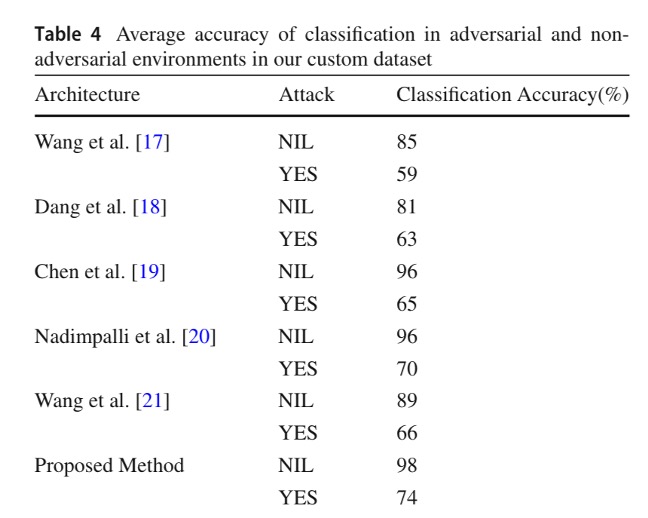
Figure 1. The model reported by Asha et al. (2023) achieved 98.4% accuracy under standard testing conditions. When adversarial attacks were introduced, accuracy decreased to 74.27%, representing a drop of about 24 percentage points.
Figure 2:
| Dataset tested | Performance score |
| FaceForensics++ (Deepfake) | 98% (accuracy) |
| DFDC | 75.3 (AUC) |
| Celeb-DF | 54.8 (AUC) |
Figure 2. Saif and Tehseen (2022) summarized results from multiple deepfake detection studies and found that the same model often dropped sharply when tested on a dataset it was not trained on.
For example, one detection method MesoNet achieved 98% accuracy on the FaceForensics++ dataset but fell to 75.3% and then 54.8% AUC on the DFDC and Celeb-DF datasets. The original survey reports accuracy for some datasets and AUC, a related performance score, for others; in both measures, a higher value means better performance. Either way, the same model performed far worse once it was tested on unfamiliar data.
Figure 3 :
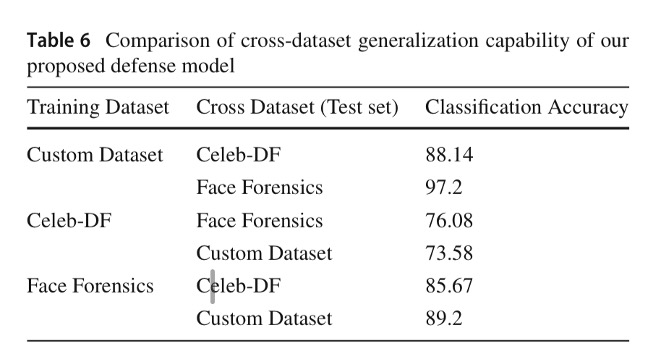
Figure 3. Asha et al. (2023) also tested their own model across datasets, and the results depended heavily on which dataset it was trained on. A model trained on Celeb-DF achieved about 76% accuracy on FaceForensics and 73.58% on the custom dataset. In contrast, a model trained on FaceForensics generalized better, reaching 85.67% on Celeb-DF and 89.2% on the custom dataset. Because this comes from a direct experiment rather than a survey, it provides primary evidence of the same cross-dataset weakness shown in Figure 2.
Figure 4;
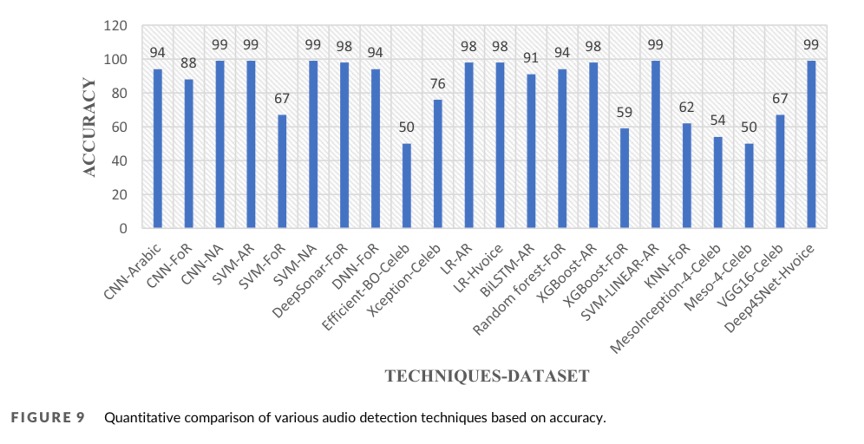
Figure 4. Across the audio detection methods reviewed by Dixit et al. (2023), accuracy ranged from roughly 50% to 99%, depending on the method and dataset. The same approach often varied sharply across datasets — for example, an SVM scored 99% on the Arabic and H-Voice datasets but fell to 67% on the FoR dataset, and on the more realistic FakeAVCeleb dataset, most methods dropped to between 50% and 76%. This mirrors the cross-dataset weakness seen in the video studies (Figures 2 and 3).
Across the three studies, the reported results consistently showed that deepfake detection models performed best when testing conditions closely matched their training data. Larger decreases in accuracy were seen when the models met unfamiliar datasets or adversarial attacks, showing that changes in testing conditions noticeably affected overall performance.
The results support my original prediction that cross-dataset testing would reduce accuracy more than adversarial attacks. In the studies summarized by Saif and Tehseen (2022), some models that achieved nearly perfect accuracy on familiar datasets dropped to about 54% when evaluated on different ones, while Asha et al. (2023) reported that adversarial attacks reduced one model’s accuracy from 98.4% to 74.27%. Both conditions hurt performance, but the larger decrease came from testing on unfamiliar data.
A likely explanation is that some detection models learn patterns specific to their training datasets rather than features that consistently separate authentic from manipulated media. Such models perform well on data resembling what they have already seen but lose accuracy on new datasets. This comparison has limitations, however: each study used different models, datasets, and testing methods, so the differences in accuracy cannot be attributed solely to the testing conditions.
The same pattern appears in audio detection. In Dixit et al.’s (2023) review, identical methods produced quite different results across datasets an SVM that reached 99% accuracy on two datasets fell to 67% on another, and most methods dropped to between 50% and 76% on the more realistic FakeAVCeleb dataset. This shows the generalization problem is not unique to video, strengthening the overall finding that detection models struggle beyond the data they were trained on.
Taken together, the three studies show that high accuracy under controlled conditions does not guarantee robust performance in the real world. In the video studies, the largest decreases ranged from about 24 to 46 percentage points, and the audio review showed comparable swings of more than 30 points. This matters because the settings where these tools would be used in social media platforms, law enforcement, and legal proceedings are far less controlled than a laboratory, which is exactly where accuracy falls most.
Overall, the evidence suggests that current deepfake detection systems still struggle to adapt to conditions outside their training environments, and more research is needed before broad conclusions can be drawn. As the technology improves, building models that generalize across datasets will become increasingly important. Future work should evaluate video and audio detectors using consistent testing procedures and larger collections of real-world data before these systems can be relied upon for content moderation, fraud prevention, or legal investigations.
References
Asha, S., Vinod, P., & Menon, V. G. (2023). A defensive framework for deepfake detection under adversarial settings using temporal and spatial features. International Journal of Information Security, 22, 1371–1382. https://doi.org/10.1007/s10207-023-00695-x
Dixit, A., Kaur, N., & Kingra, S. (2023). Review of audio deepfake detection techniques: Issues and prospects. Expert Systems, 40(8), e13322. https://doi.org/10.1111/exsy.13322
Saif, S., & Tehseen, S. (2022). Deepfake videos: Synthesis and detection techniques – a survey. Journal of Intelligent & Fuzzy Systems, 42, 2989–3008. https://doi.org/10.3233/JIFS-211783

